I have walked the Lands Between as a shade, a phantom resurrected by grace, and even now in 2026, the echoes of its colossal heartbeats still drum against my ribs. The game has calcified into legend, yet its community—ever devoted, ever deranged—continues to unearth new geometries of wonder. One such cartographer, the Reddit archivist max-zilla, has gifted us a size comparison chart so meticulous it feels like a priest’s illuminated manuscript of the apocalypse. To gaze upon it is to measure one’s soul against a ladder of fang and sinew, to see the humble rat scaled beside the flaming god-mountain, and to understand, with a shiver, that in Elden Ring, dimension is a poem whose last stanza always reads: You will die.
In the early days, I learned what every Soulsborne pilgrim learns: death wears no fixed silhouette. The basest wretch can unmake you; the most towering demigod can be felled by a naked fool with a club. But size, ah, size is the canvas upon which terror paints its most indelible frescos. The new player’s first gasp might be reserved for the Tree Sentinel, a golden exemplar of equine cruelty, yet that is but a foreword to a library of giants. What max-zilla’s work reveals is a taxonomy not of threat level but of awe—a vertical symphony where each tier hums a more devastating chord.
The Unseen Ladder: From Motes to Mountains
The chart, like some mad naturalist’s scroll, unrolls across nine strata of existence. At the foot, clustered like barnacles on reality’s hull, are the minuscule: Misbegotten scavenging with bone knives, rats whose whiskers twitch with murderous intent, and the half-seen imps that fling blood-loss projectiles from the dark. These are the whispers before the scream. I recall how a lone rat, no larger than a housecat, once staggered my rune-laden hero into an open grave. In Elden Ring, the small are assassins of complacency, and the chart parades them without condescension.
Ascending, we meet the human-shaped—knights, sorcerers, and the fleshy cadres of Leyndell. Their familiarity breeds a tragic intimacy; you can measure their height against your own silhouette, and in that mirror you see the cruelty of gods who crafted soldiers from vulnerability. This median world is a memento mori reminding us that even the ordinary here is forged in sorrow.
Then the ladder stretches until vertigo becomes a companion. Godrick the Grafted, a centipede of stolen limbs, hulks over his courtyard like a gothic weathervane of flesh. Radiant Praetor Rykard, swallowed by the serpent, unfurls into a nightmare of scale, a molten river of teeth and greed that could drown a castle. The Fire Giant rises like a dormant volcano given vindictive sentience—a slow-moving furnace-heart whose every stomp births a lava-lake. And Astel, Naturalborn of the Void, is a constellation of malevolence, a shattered galaxy hurled into our plane, its body a chandelier of bones from some collapsed dimension.
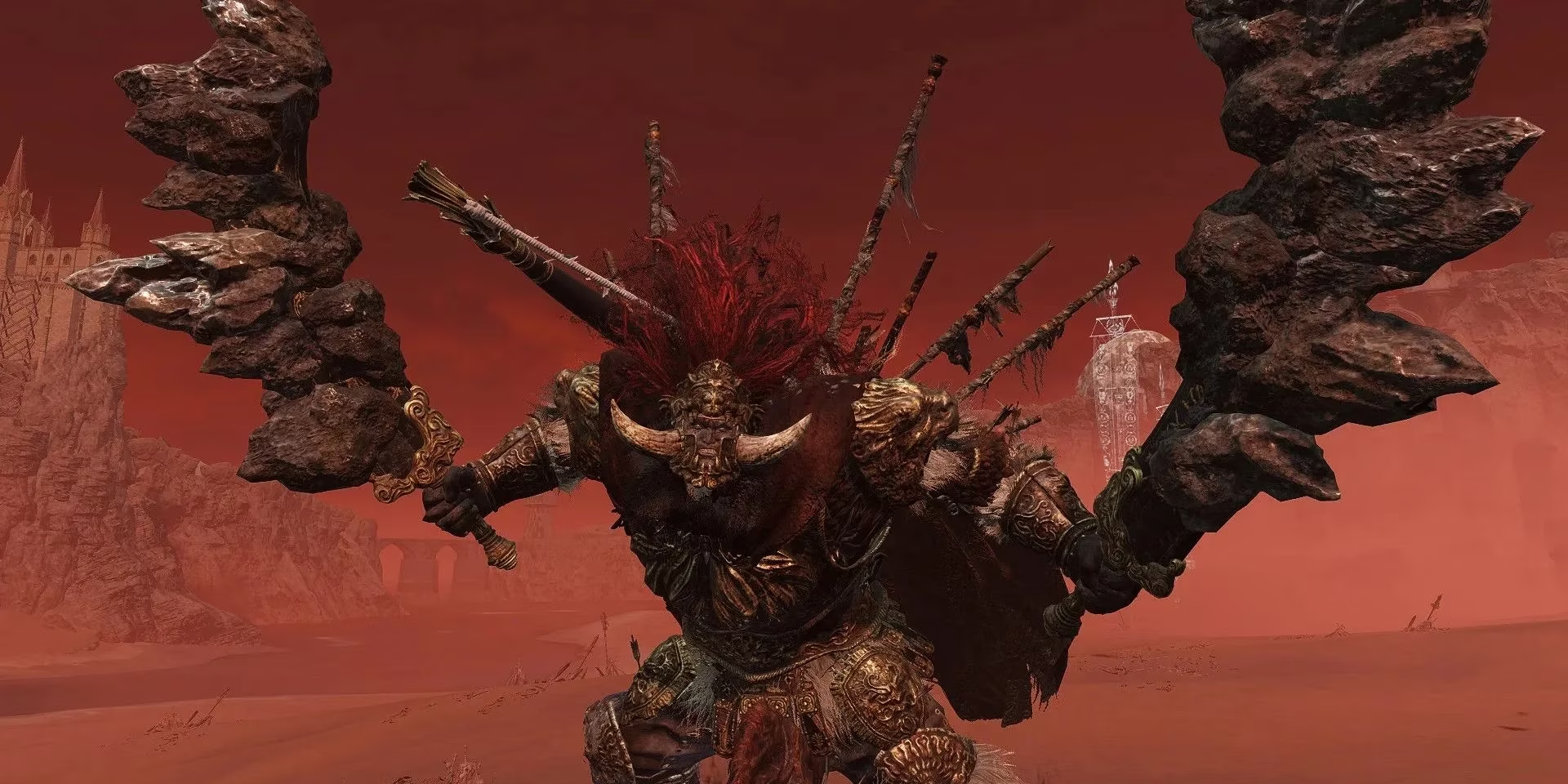
Starscourge Radahn, whose image hangs in my mind like a blood-red tapestry, occupies a strange vertex on this chart. He is immense yet diminutive upon his horse, a gravity-crushed titan reduced to a tragicomedy of proportions. The game’s own lore frames him as a walking paradox—a colossus who conquered the stars only to be diminished by the rot. Max-zilla’s placement of Radahn beside other prodigies like the Elder Dragon Greyoll contextualizes him anew: he is a broken world, a gravitational anomaly still capable of pulling meteors from the sky, yet his silhouette, once seated, barely surpasses the rotten tree spirits that slither through catacombs. It is a lesson in humility, drawn to scale.
The Cartographer’s Gift: A Blueprint of Nightmares
Before this chart became my desktop scripture, the community relied on rougher methods. I remember the boss battle royale mods that set Malenia against Radahn in a blender of chaos, useful for a chuckle but terrible for sober comparison. The combatants darted like fever-dreams, their true grandeur blurred by laser-saws and scarlet rot explosions. Max-zilla’s stillness is a rebellion against that chaos. By pinning each entity to a fixed backdrop, the chart becomes an atlas of doom, a silent lecture on the relative architecture of despair. Fan artists—the limners who immortalize these horrors—now have a blueprint as precise as an astronomer’s star chart. They can sketch Placidusax’s ancient dragon form without shrinking him into a mere lizard, or capture the true blasphemy of Rykard’s coil by measuring it against a Misbegotten Warrior.
The chart also reawakens forgotten curiosities. Who knew that the rotund Godskin Noble, a belly wrapped in holy skin, stood shoulder-to-shoulder with the proud Leonine Misbegotten? Or that the Fallingstar Beasts, those cosmic bullets with mandibles, rival the height of a mounted Tree Sentinel? These juxtapositions are the ink of inspiration. I have seen works born from this chart that depict an unlikely tea party among the titans, or a melancholic sketch of Radahn and Godrick comparing grafted arms like two poets comparing verse. It is as if max-zilla gave us a linguistic key to a new dialect of fan-lore, a visual lexicon where scale becomes sentence structure.
Why the Gigantic Still Sings in 2026
Some might ask why, four years after the game’s release, a mere size chart still sends ripples through the community. The answer rests in the very marrow of Miyazaki’s design: the Lands Between is a world where proportion equals poetry. A dragon is not just a dragon; it is an autobiography of catastrophe, a sky-scar rendered in scales. The Erdtree itself, invisible in the chart but always the silent adjudicator of scale, transforms every living thing into a verse of a larger epic. When I study this chart, I am no longer a veteran; I am a pilgrim again, my neck craned to the heavens, my shield hand trembling. The Fire Giant’s foot, if scaled faithfully, would cover a village. Rykard’s face, once unveiled, could swallow a score of Tarnished in a single yawn. These are not statistics; they are a form of secular worship.
In 2026, the game endures not just through its DLC echoes but through artifacts like this chart. It is a fossil of communal passion, an exoskeleton of shared memory. Every line on that parchment is a scar from a thousand deaths, and every figure, even the humblest vulgar militia, carries a gravity that belies its centimeters. To hold the chart is to hold a mirror to the abyss, and in that reflection, I see myself—a tiny, tarnished mote, eternally fighting against the geometry of the impossible. And for that, I am grateful. Max-zilla has not just measured monsters; they have charted the very contour of our awe.
Source: max-zilla/Reddit